

School-Related Personnel: The Backbone of Public Education
By Cortney Marabetta, Communications Specialist
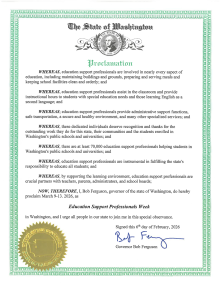
Last month, Governor Ferguson proclaimed March 9th through 13th as Education Support Professionals week. In so doing, he acknowledged the work that ESPs do in our schools – maintaining grounds and buildings, cleaning classrooms, driving buses, preparing meals, supporting students one on one, and all of the many other underappreciated jobs that make our schools safe and welcoming places for students to learn and thrive in.
You can read the full text of the proclamation here.
This summer, we plan to take the Governor at his word and begin the conversations with legislators around wages, staffing needs, and other improvements we can request of the Legislature next session. Your input is crucial as we gather information about what ESPs need – talk with your local’s board if you have ideas for improvements that aren’t on our radar.
Watch for opportunities to raise your voice and make the Legislature hear you: your work is valuable and essential. As the proclamation notes, you are a crucial partner to parents, teachers, administrators and, most of all, students. We want to take this opportunity to thank you for that work and recognize your commitment to our schools, and we want to call on the Legislature and the Governor to do more than verbally support you and our students and schools.
Fighting To Save The Parent Education Programs In Washington State
By Cortney Marabetta, Communications Specialist
Last fall, the State Board for Community and Technical Colleges and the Washington Association of Community and Technical Colleges made changes to the Funding Allocation Model that outline how college funds must be used. Those changes remove funding for programs that do not provide certificates or other degrees as outcomes. This eliminates the parent education and cooperative preschools in Washington State's Community and Technical Colleges.
A coalition of parents, faculty members, alumni, and others have come together to push the SBCTC to preserve the parent education program; the board had discretion in how they designed the model and chose to exclude programs that do not directly have workforce outcomes. This is despite the long-documented impact of the parent education program on families and communities.
For more than 80 years, these programs and their cooperative preschools have been thriving early childhood education models and a defining example of community vocational education in this state. This is particularly devastating to the approximately 4500 families impacted by the closure, since it takes place as the state is reducing its overall number of early childhood education slots, leaving families with children with very few options for affordable, effective childcare.
As of this writing, members of the program have sent over 6,000 letters to the SBCTC, and have connected with a number of state and local legislators, as well as with reporters. 14 legislators have also sent a letter to the SBCTC, expressing concerns that closing these programs will tighten access to childcare, prevent parents from returning to the workforce, and undercut a vital pipeline for our state’s early childcare workforce – their request is that SBCTC restore the funding to preserve the programs for a year and allow other solutions to be found.
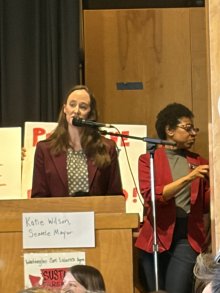
Over 200 people attended a press conference held Saturday, April 4th that had a number of speakers, including Senator Rebecca Saldaña, Representative Gerry Pollet, and Seattle mayor Katie Wilson. Our next action is a rally at the SBCTC board meeting on April 9th.
We are circulating a petition calling on the SBCTC to work with the affected colleges and programs to avoid these closures. The programs are pursuing different options so there is not, at this time, a one-size-fits-all approach to advocate for. We urge you to sign it and share with your local networks. More to come!