

Leading By Example By Taxing Wealth, Not The Working Class
By Emma Scalzo, Executive Director, Balance Our Tax Code
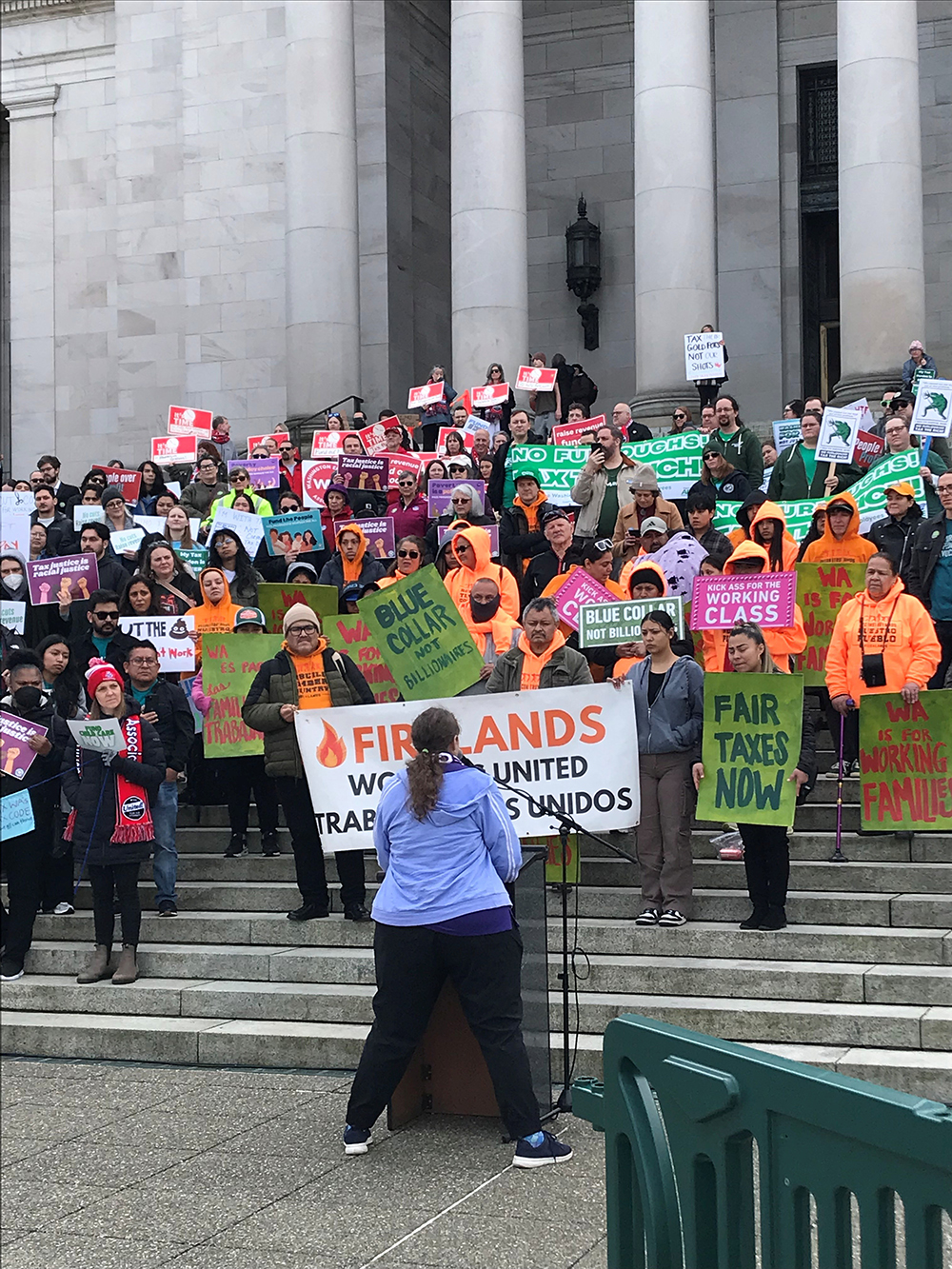
Rally at the state Capitol for progressive revenue on March 17th. Photo credit: Cortney Marabetta
The events of the past year reminded me that being a taxpayer used to be a point of pride. Whenever I pay my little bit in taxes, I think of the scientists who keep our food from being recalled, the healthcare workers in rural clinics, and the park rangers that take care of our nature. I think of the teachers that taught me how to count, and the public TV shows that taught me my colors. If I have learned anything this year, it is that the people of Washington have funded the things I love most about our state.
That is why many of us are so upset at the mega-budget that the Republican Congress passed, which will slash funding for healthcare, food security, renewable energy projects, and student loans. At the same time, they are giving the wealthiest 1% of people over $1 trillion in tax cuts over the next decade.
Although the national situation is bleak, we hope that the public outcry against the massive federal tax breaks will push our state lawmakers to finally stand up for working taxpayers. Many Washingtonians don’t know that our state tax structure heavily favors the wealthy few and chronically underfunding our public programs. While the average public school teacher pays $11 in state and local taxes for every $100 they make, their billionaire neighbor only pays about $4. Since the state over relies on regressive taxes – like sales and property taxes – wealthy corporate CEOs continue to funnel in record profits almost tax-free and we all suffer the consequences of critically underfunded schools. Our tax code has the lowest-paid workers in Washington paying a 3x higher local tax rate than the wealthiest 1%.
Washington is in a critical position at this point in our history. As other states choose to restrict reproductive care, remove protections for their clean air and water, and target immigrants with discrimination and inhumane treatment, people are increasingly looking to progressive states like Washington to be a leading example, or haven. But unless lawmakers fix our upside-down tax code, we won’t be able to deliver on the values we profess. Social progress and good quality of life requires funding. The good news is that our state has plenty of resources, if only we reform our tax system.
So why does this unjust system continue? This year’s legislative session provides a great example. Our state lawmakers saw the $16 billion revenue shortfall, and knew it was time to even out the tax code for working families. Each legislative chamber put forward their versions of a tax on extreme wealth to fill the big revenue gap, balance the budget, and keep Washington’s most critical programs alive.
Big tech and wealthy corporations immediately showed their political cards. Some of Washington’s most powerful corporate lobbyists, funded by millions of PAC dollars, pulled strings from behind the scenes to ensure that didn’t happen. It worked, too. Our state failed to pass the many of the progressive taxes on the table. Instead, months before the federal cuts were passed, our state was already announcing major budget cuts for higher education, reproductive care, and childcare.
With the legislature reconvening in January, we must demand that our lawmakers resist corporate pressure and fix the root of the problem.
The first step is to pass the taxes that actually account for peoples’ ability to pay. The leading option is the Senate Bill 5797, a tax on excessive Wall Street wealth. This would be a small tax (1%) paid only on Wall Street profits over $50 million. Currently, people can hoard as many stock market assets as they want without paying any taxes.
Another good bill is SB 5796, which would make corporations start paying payroll taxes on their highest salaried employees. Currently, wealthy companies do not pay payroll taxes for social programs on employee salaries above $176,100.
These progressive-vetted options could provide billions every year for Washington’s social safety programs, affordable homes, and healthcare. These funds would also finally adequately fund our public schools, special education services, and the educators like you that are shaping the next generation.
Our state lawmakers meet again this January, and they already anticipate being met with millions of dollars of pressure from the wealthiest CEOs in the nation. We must remind them that we can no longer tolerate a tax code that protects a few peoples’ pocketbooks at everyone else’s expense. Let’s make ourselves heard in Olympia this session as the parents, teachers, caregivers, and other state employees who are ready to fund our future.